[phd logs, 2] crafting academic ergodicity
on an ambitious project
When I read Lee Maracle's Memory Serves for my mnemonics class, where Maracle shifts from writing in regular font to italics to tell us of her theory through experience, a hazy realization came to me: this is how I make theory feel alive. A long contention/unease I have with theory texts – as much as I love them – was the fact that they seem un-grounded. This, Maracle's piece, is what theory is supposed to be, how it is meant to be understood. She doesn't extract theory from experience, she produces it.
Ergodic literature, the term, was popularized by Espen J. Aarseth in Cybertext: Perspectives on Ergodic Literature. I will give you a list of phrases and sentences (from Aarseth's first chapter) that, put together, should give you an idea of what it means:
- intricacies of the medium is an integral part of the literary exchange
- nontrivial effort is required (by the reader), to allow the read to traverse the text
- there, necessarily, is a feedback loop
- there's a constant reminder of inaccessible strategies and paths not taken, voices not heard: all because of the choices you, as reader, make; it will make things either more or less accessible
- the stakes of interpretation are raised to stakes of intervention
- it is a form of function-oriented perspective
- there's a relocation of attention
RPGs or text-based adventure games are a stellar example, of course. But this ergodicity is also very translatable to printed forms of writing. Few good examples are House of Leaves by Mark Z. Danielewski, S. or Book of Theseus by Doug Dorst and conceived by J. J. Abrams, Pale Fire by Vladimir Nabokov. I would argue, for me, Maracle's book falls somewhere in the spectrum too.
When I started ideating for my final paper for this class, it was a no-brainer that I wanted to experiment with this form. A key word that I was to inject here in relation to ergodicity is interactivity. Maracle's piece is less so, and I want mine to be more so.
I thought about it quite a bit, for quite a while, for too long of a while, tiring-ly so. It was exciting, and it is something I want as part of my career as an academic. I knew the main text I want to work with is The God of Small Things by Arundhati Roy. I have worked with it previously for a course during my undergrad, and then, too, it was presented through Twine with hyperlinks to respond to Aijaz Ahmad's article on the book. The book lends itself to ergodicity easily. The paper is on memory. But this is only one of the two texts; the second 'text' is my experience of my dad's brain stroke and his memory loss.
This is where I start skipping and stumbling and stuttering. I have my two texts, I know the category of the form, I have my professor's excitement, I have some rough ideas and lots of books, I have intense ambition. What's next? How's next?
This is usually the best part of writing a paper. Ideating, going through texts and articles again and again, drawing links and physical mindmaps, exhausting yourself. My scrivener 'final everything' file is slowly getting crowded (or, at least, I want to believe it is);
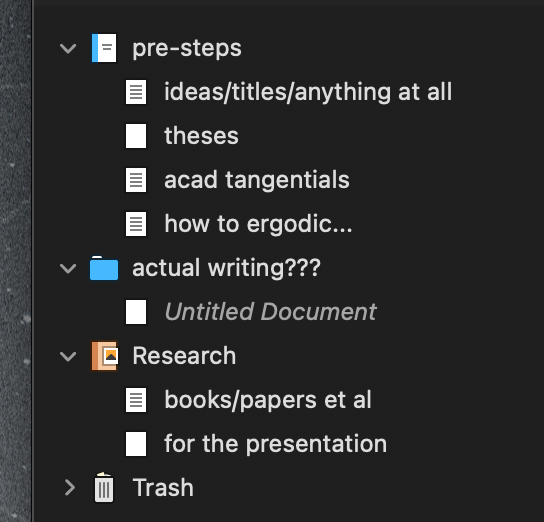
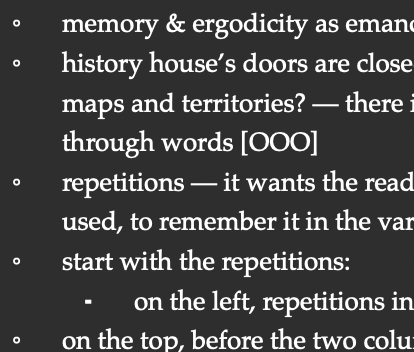
My progress thus far includes a heavily annotated GoST book, the Aarseth book, Missing Out by Adam Phillips, articles on phenomenology and archaeology of untouchability by Gopal Guru and Sundar Sarukkai (and their book The Cracked Mirror), Caste by Isabel Wilkerson, Capitalist Realism by Mark Fisher, Production of Space by Henri Leferbvre, Lefebvre, Love & Struggle by Rob Shields.
I have started experimenting with forms & formats, and as of now I am settled on a two-column organization. I have experimented with the form here, and have been more or less trying out how to visually make it work. It will need a collaboration between Scrivener (my main writing software), Word (that allows for two column organization...poorly), and Affinity Publisher (for final formatting).
Designing (physically and logically and literarily) is definitely adding to my already overwhelming workload, so why am I spending so much time on the form? To put it in simple words: because over time this is the kind of academic writing I want to focus on. My main area of research is/will be video games, interactive narratives, and game-like narratives, and this is a great way to combine my interests that otherwise do not overlap. I want to understand how writing can be experienced in ways that isn't through passive (using the word non-trivially) reading or linear perusal. And what better way of understanding it than doing it myself? It is ambitious but I am willing to take the risk.
My ideation process is...messy. I like it this way because it makes me keep track (yes! really!) of ideas. And currently, the intersections I am working with are memory, borders/physical spaces, touch, guilt, and repetitions. These themes not only comprise of the figurative/theoretical lens I am looking at my thesis and the texts through, but most of them also make up my physical form. I did not want it to be a digital thing, although hyperlinks and page movement would have really helped, I wanted something the paper could access.
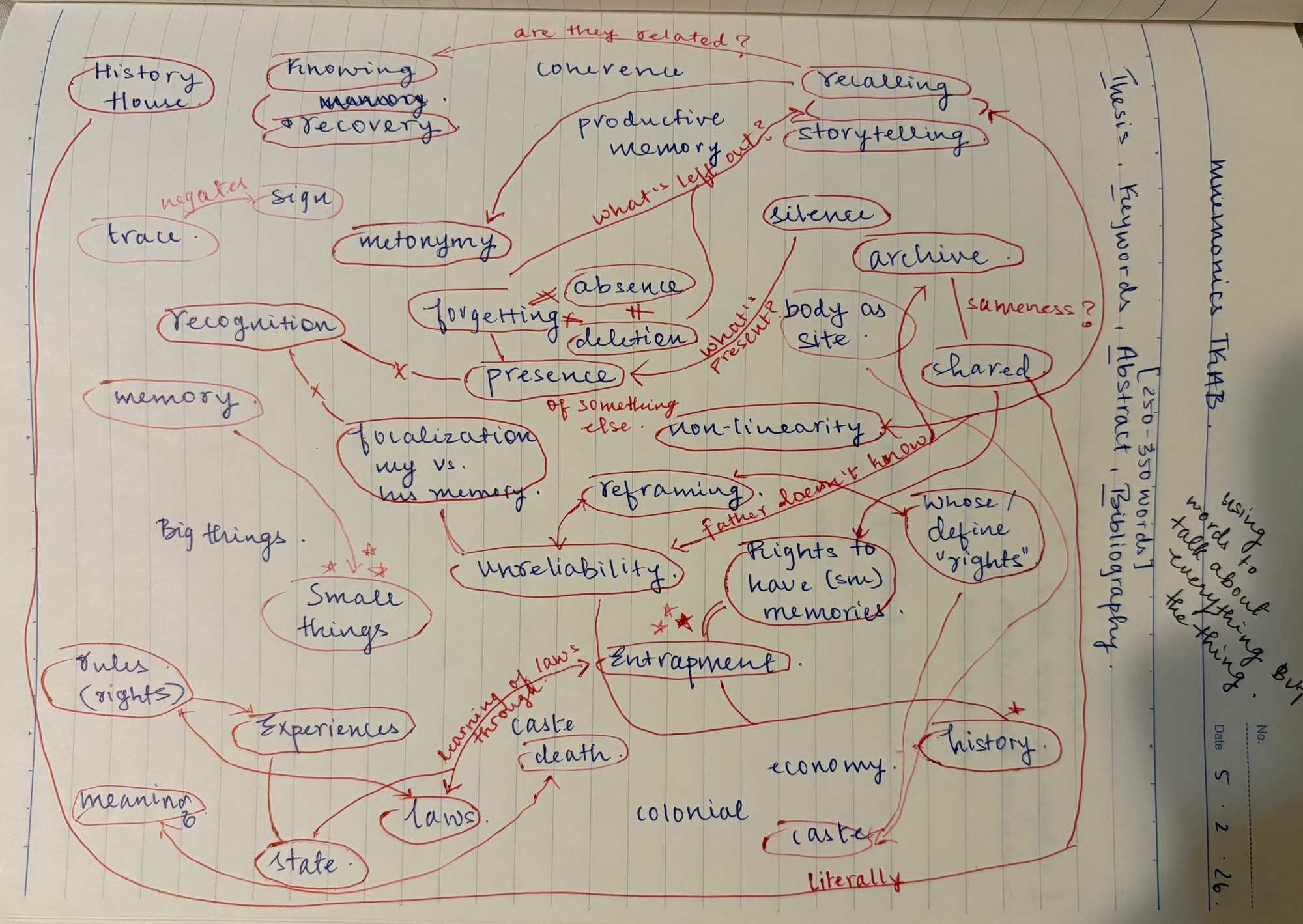
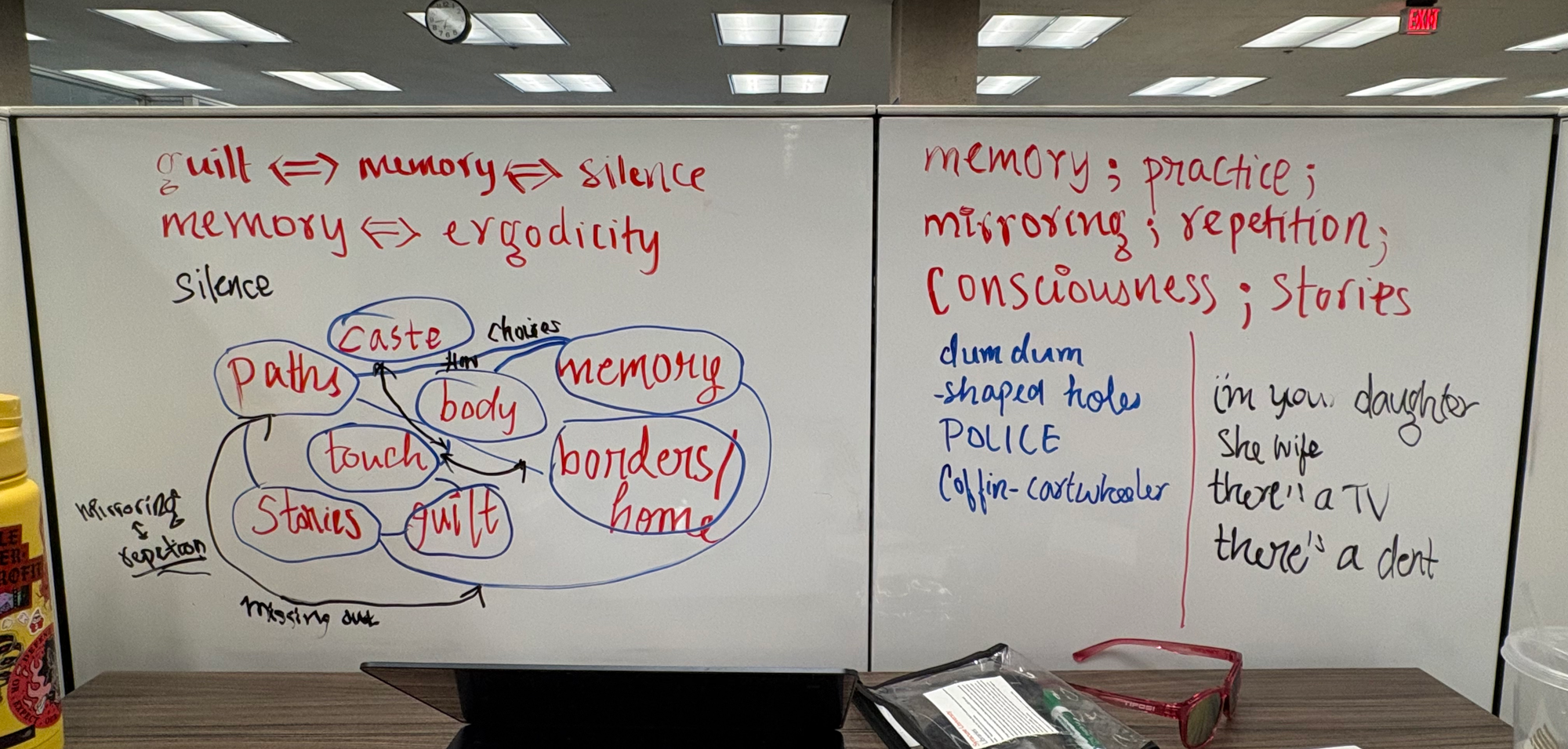
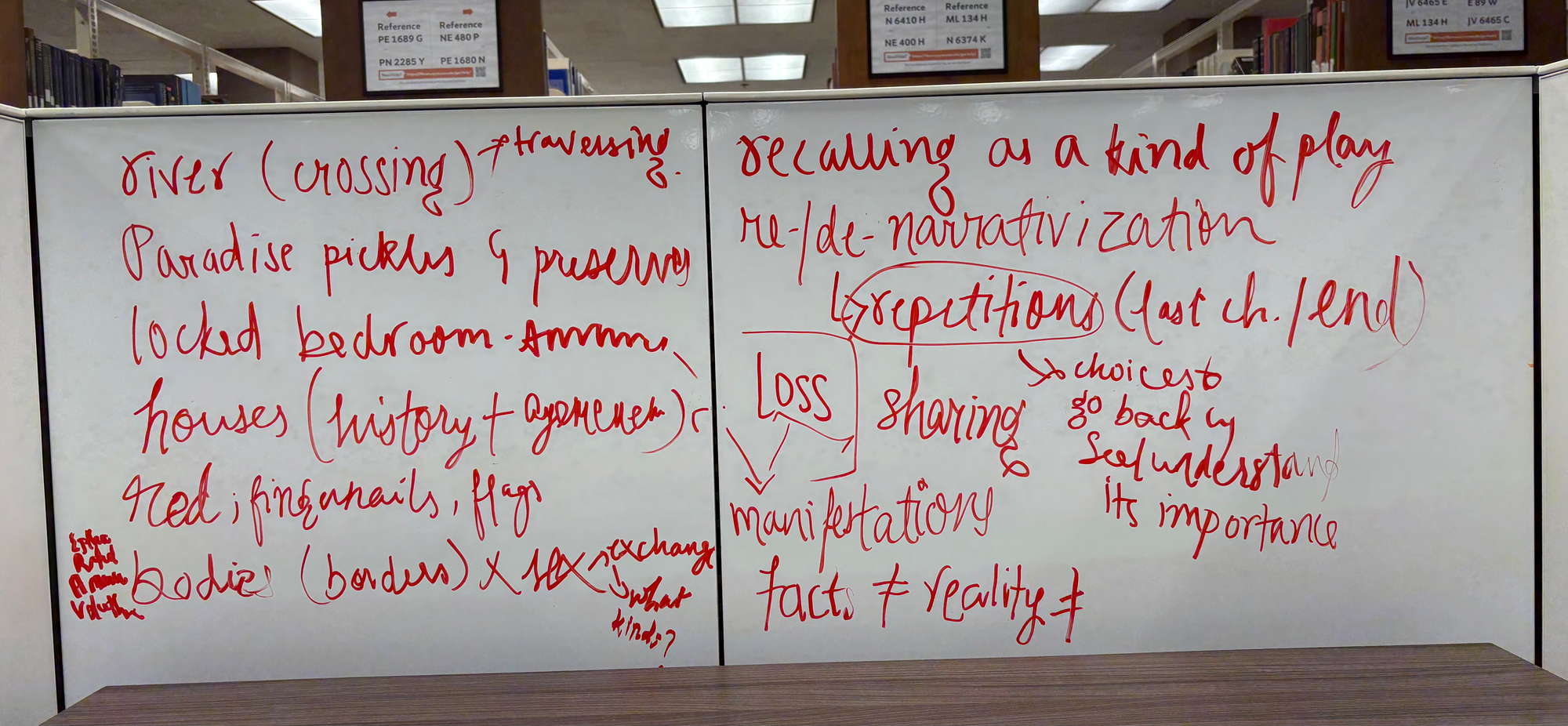
While I was ideating, I thought of a few other ways that could make this an ergodic text. repetition of pages with increasing words. repetition of paragraphs with heavy handmade annotations. footnotes. glossary-like index but paragraph definitions instead of words definitions. two-booklet forms.
But I settled on the two-column theory/non-fic. The reasons will come to me later. I will work through my paper by relocating attention. By rehearsing and premising my theoretical work on my dad's story (on the right side), I will tell my readers what to focus on within my theorization of GoST (on the left side). As with all else, the process of writing is what will finally tell me where it wants me to go.
This paper is important to me. I know it is because I am scared of writing it, which is why I am making a post about it here. Not only is this my first attempt at creating a form of theoretical project that's unconventional in the way it performs theory, it is also my experience of my dad's brain stroke. Two things I have not written in/about. As interested as I am in psychoanalysis and Frankfurt school, I had never undertaken a project to write about my dad and his memory loss; more importantly for the purposes of this project, his process of regaining those memories. I had never even thought of doing it, which is strange because I always inject myself into whatever work I am working on and with – and this is such an important event I lived through.
Ergodicity becomes integral here, too. Like a text machine, memories are capable of manipulating itself as well as the reader/vessel. Reading becomes more of a metaphor than a process, recalling becomes more of a metonymic process than an event. When I wanted my dad to remember me and his past life, who was the memory-recalling for really? there's no doubt that some part of it was selfish. Practicing memories, practicing repetitions, practicing past experiences in words to selectively remind both of us about the parts that we think are important to his person. Selective and repetitive. What is being recalled is as important as how it is being recalled.
I love psychoanalysis, I love games, I love ergodic forms. And I am beginning to find that psychoanalysis and ergodicity have so much more in common:
We choose by exclusion.
And inaccessibility, it must be notes, does not imply ambiguity but, rather, an absence of possibility – an aporia.
The trials and tribulations of wanting are born of frustration; to choose one thing may involve frustrating ourselves of something else.
The sense of individual outcome is illusory, but nevertheless the aspect of coercion and manipulation are real.
Half of these are from Aarseth's theorization on ergodicity and cybertext, other half is from Adam Phillips on missing out. Both involve a process that's "difficult progress from confusion to perception."
I will follow up on how it is turning out/turned out to be! [or may be not!] – either way, I hope you enjoyed this piece <3
~ dash