back to basics: what is the letter?
lacan, fink, frankfurt school, zizek

a queen gets a letter she really really shouldn't have. queen, king. the king walks in, so she does the bravest thing: leaves it face-up on the table and hopes. minister d on the scene. minister d spots the letter, sees her panic, swaps it for a decoy right under her nose. she cannot say a word, because saying a word would make the king look.
the police spend months turning minister d's apartment inside out, sticking needles into cushions, pushing chair legs under microscopes. finding nothing. detective dupin on the scene. wearing green-tinted specs finds it within minutes. dangling from a cheap card rack, crumpled and readdressed like junk mail. he swaps it for a fake, tucks a spiteful line of verse inside, & makes the police pay him before he hands it over.
know of the letter and not the letter, is the point.
i. lacan (god help me), or: it's not what it says, it's where it goes
lacan's first move is to take poe's story's (synopsis above) biggest mystery and shrug at it. we never learn what the letter says? good, it doesn't matter. for lacan, the letter is a signifier, meaning something that gets it power from its position in a system rather than from its content. think of it less as a message and more of a...hot potato. what's interesting/matters isn't what's written on it but what happens to whoever's holding it.
let's see what it does! the story has two thefts, same shape. in the royal apartment, the king sees nothing. the queen sees that the king sees nothing and assumes her secret is safe. the minister sees what they've both left exposed and takes it. then at the minister's place, the same positions repeat with new people. the police see nothing, the minister sees that the police see nothing and relaxes, then dupin sees everything and takes it. the minister has slid from the clever position into the queen's position and made the same mistake she did; he even readdresses the letter in a woman's handwriting, as if holding it turned him into her. lacan makes a lot of this. people don't move the letter around; the letter moves people around.
this is also why the police fail. they're looking for an object hidden in physical space, so they measure, probe, drill. but in physical space, everything is exactly where it is, always, so nothing can be missing. something can only be missing from its place if there's a system that says where its place is. lacan's example is a library book: it is only lost because the catalogue says it belongs on a shelf where it isn't. the letter isn't really hidden in the apartment. it is missing from the queen's hands, and that's a symbolic problem, not a spatial one. the police are searching the wrong kind of space.
the minister's power only lasts as long as he doesn't use the letter. the moment he shows it to the king, his leverage is gone. the letter works as a threat by sitting still.
lacan's seminar starts from freud's idea of the repetition compulsion, our habit of replaying the same painful scenes even when they bring up nothing but trouble. lacan's twist is that we don't repeat because of some buried content that keeps pulling us back. we repeat because of structure. each of us is born into what he calls the symbolic order: language, names, family roles, laws, the whole web of signs that was running long before we showed up and that assigns us our places in it.
we like to think we're the authors of what we mean, but lacan says the subject is closer to an effect of the signifiers passing through us, a position we're put in rather than a self we choose. the story stages exactly this. nobody knows what the letter says, & everyone is steered by it anyway. taking turns with the same blindness. that's also a decent description of the unconscious: a message we can't read that keeps organizing our lives, the way the letter organizes theirs. it is why, elsewhere, lacan insists the unconscious is structures like a langu7age.
i know im writing a lot more about my readings & courses & phd. but i've no life outside it rn :]
i.i. the deleted app
i sent a string of messages and then deleted the app. don't remember what exactly i said, lacan tells me i don't need to. the messages keep doing their work because of where they are: on someone else's phone, on a server, in a thread that still has my name at the top.
the positions line up, too. the people in my life who don't know the messages exist see nothing. having deleted the app, i see that they see nothing and conclude the messages are gone. queen's mistake. whoever still has the thread sees what i've left exposed. the screenshot of them that's never sent is stronger than the one that is.
the app hands us lacan's library book too. when a message is deleted, the thread doesn't close up around the gap. it leaves a gray bubble announcing that a message used to be there. the system marks the spot where something should be. missing from its place, rendered as interface.
then, the read receipt. seminar in two tiny ticks, really. delivered. seen. neither tells you what the message said. both tell you where it went, that's the part we want to know. lacan ends the seminar with his famous line: a letter always arrives at its destination. let's get to others who fight about it.

ii. fink, or: what the chain leaves behind
if lacan is the guy who throws you into the deep end, fink teaches you how to swim...or at least how to float. or, like, find something to not drown. enter lacan: he stops talking about poe and starts flipping coins. i am going to try my best with this math-y section:
flip a coin over and over and over and write down the results. heads. heads. heads. tails. heads. yes, more. that's pure chance, no pattern and no memory. now, group the results in threes and give each group a label. three of a kind [hhh or ttt] is a 1. a perfect alteration [hth or tht] is a 3. everything else a 2. because each group shares two flips with the next one, something odd happens. a 1 can never be immediately followed by a 3. hhh can only become hhh or hht. never an alteration. nobody made that rule. it appeared the moment chance was put into a code.
fink's point is that this is how the symbolic works. start with randomness, add a system of signs, and suddenly there are laws: things that can happen and things that cannot. the chain even develops a kind of memory! since what it can do next depends on what came before. and every set of rules produces a pile of impossible combinations, the sequences the code will never write. lacan calls this leftover the caput mortuum, an alcchemist's term for the residue left in the flask after distillation. fink links it to the real. there's a real that exists before language, and there's the real that language itself produces as its leftover, the stuff it cannot include. later, lacan will define the real as what never stops not being written.
this is where a letter always arrives at its destination starts to wobble. something in the circuit never arrives anywhere, & it's not because it got lost in the mail. the rules of the circuit exclude it. the remainder also isn't just dead weight. it haunts the chain, & more than that, it drives it. the chain keeps circling what it cannot write, the way you keep circling a word on the tip of your tongue. lacan eventually gives this driving leftover a name, object a: the cause of desire, the thing we chase precisely because it can never be captured. [displacement, metonymy].
let's go back to poe with this in mind. the letter's contents are the story's caput mortuum. nobody can say what's in it. the queen can't say it without the king finding out, the minister can't use it without losing his power. poe never writes it down. the contents are exactly what the plot's rules exclude, and that exclusion is what keeps the plot running.

ii.i. the deleted app
most messaging apps let you unsend a message only within a certain window. after that, the rules make recall impossible. the same way a 1 can never become a 3. remember the little gray bubble announcing a deleted message? caput mortuum with a user interface. the system cannot show the message, but it has to show that it cannot. it writes down its inability to write.
& the messages i can no longer read don't just sit quietly on someone else's phone. they're why i'd think about reinstalling at 2am. why i'd try to reconstruct what my fingers typed, why the thread feels louder than it would if i could just go back and check. gone from my own record, they keep coming back. that's the remainder: excluded by the rules, and running the whole show because of that exclusion.
which raises the...obvious question. what if we could just get back into the conversation?
iii. habermas, or: what if we could just talk about it?
habermas is entering from a different building entirely. leading figure of the 2nd gen of the frankfurt school, the german critical theory tradition that combined marx & freud to explain why modern societies keep producing domination while promising freedom. adorno & horkheimer [<3] ended up pretty bleak about it: reason itself had become a tool of control. habermas wanted a way out, and he found it in communication. when people talk honestly, trying to understand each other rather than win or manipulate, reason is still alive. the trouble is that communication almost never happens that way. power, money, fear, secrecy. all blended. his name for the result is systematically distorted communication.
in knowledge and human interests, habermas turns to psychoanalysis as the model for fixing it. for him, a symptom is a piece of language that's been kicked out of the conversation. [aside: going back to fink going to lacan, if desire of metonymy, symptom is metaphor. condensation]. symptom, kicked out of conversation. repression takes certain meanings and excommunicates them from shared language, so they survive only in private code the person can no longer read, even though the code is their own. cut off like this, those meanings stop behaving like meanings and start behaving like forces: you do the thing, you don't know why. analysis, which he calls depth hermeneutics, translates the private code back into shared language. once you understand the symptom, it loses its grip. self-reflection sets you free.
this sounds close to fink, but the difference is huge. both of them think something has been excluded from the chain and keeps acting on it from outside. for fink, though, the rules of language produce that exclusion, so there's no version of the chain without a remainder. for habermas, repression and domination produce it, & whatever has been done can be undone. the remainder is a wound, not a structure, and in principle the letter can arrive whole. habermas later turns this into an ideal he calls the ideal speech situation: a conversation free of coercion, where the only thing that wins is the unforced force of the better argument. nobody thinks such a conversation actually exists. it's a yardstick for measuring how bent our real conversations are.
habermas never wrote about poe, so this is entirely on me. read the story with a habermas-ian squint & it becomes a case study in distorted communication. the queen can't say it is mine in front of the king. the minister's leverage depends on everyone staying silent. the police are sent to recover the letter without being told what's in it. the royal apartment, in an ideal speech situation: the contents get said out loud, argued over in the open, blackmail evaporates. the police even fit frankfurt's picture: with their needles and microscopes, the prefect's men are instrumental reason at its purest, all method and thoroughness & no understanding. dupin hands the letter over only after prefect writes him a check, so truth arrives as a transaction.
iii.i. the deleted app
on habermas' reading, deleting it was a small act of repression. i took messages i wrote & excommunicated them from my own record. now they live in a code i can't access. pushing me around at 2am is the symptom. his cure is disappointingly sensible: reinstall, read, figure out why i needed them gone, maybe even talk to the person. bring the text back into the conversation, and it stops being a force and becomes a meaning again. he'd also probably say that the app is part of the distortion. the conversation took place on terms set by a company that cares about engagement & data rather than understanding, which is his larger worry about power steering how we talk.
then there's something genuinely appealing here. habermas gives us a reason to keep trying to talk, and a standard for criticizing power. the lacanian side has often been accused of the opposite: if distortion is permanent, why fight it? but after fink's coin tosses, it is hard to believe the letter could ever arrive without leaving something behind.

iv. zizek, or: it arrives anyway
the slovenian pop philosopher who made lacan famous outside the seminar room by reading him through hegel, hitchcock, dirty jokes...& whatever else was within reach. in enjoy your symptom! he takes lacan's closing line and puts it right in the chapter title. why does a letter always arrive at its destination?
the line needed defending because derrida had attacked it in the 1970s. he argued that lacan's reading was too tidy, like a circuit that always closes and a truth that always get delivered. for derrida, the defining feature of any letter is that it can always not arrive. it can get lost, split, misread, delayed forever. and that possibility is built into writing itself. at first glance, this sounds (again) a lot like fink's remainder. & seems to leave lacan's line looking naive.
zizek's answer is: of course letters go astray, and that's how they arrive. presented by three ways of reading lacan's sentence.
a letter always arrives at its destination the imaginary. a letter arrives at its destination because whoever it reaches recognizes themselves as its addressee. think of reading a horoscope or a tarot tower card and gasp! zizek connects this to althusser's idea of ideology [because who would zizek be if he didn't bring at least a dozen other theorists into it?]: a police officer shouting 'hey you there!', you turn around, you've accepted that the call was for you. the destination doesn't exist before the letter arrives, the arrival creates it. in poe, everyone who holds the letter becomes the person it concerns.
a letter always arrives at its destination the symbolic. lacan's own formula: sender gets their own message back in inverted form. poe delivers this with almost suspicious precision: dupin's fake letter contains a line from a french tragedy about atreus, the mythological king who served his brother a meal made of his brother's own sons. that's the ultimate case of being fed your own message. the minister's trick comes back to him in dupin's handwriting.
a letter always arrives at its destination the real. here zizek reaches for an old fable, often told as the appointment in samarra. a servant sees death in the baghdad marketplace, panics, flees to samarra. later, death tells the servant's master she was surprised to see him in baghdad, since she had an appointment with him that night in samarra. his escape was how he kept the appointment. poe has his own version. not knowing the letter is gone, the minister will keep blackmailing the queen as if he still held it, and that confidence will ruin him. in zizek's terms: the letter that always arrives is the thing we can't escape, and our attempts to escape it are how it reaches us.
this is also where zizek & habermas part ways for good [?]. habermas wanted to remove the distortion so the message could get through. zizek thinks the distortion is the message. the detour, the missed encounter, the fact that the letter went through the wrong hands is where its truth lives. fink's remainder isn't something that failed to arrive. it's the form the arrival takes.
iv.i. the deleted app
what if i disabled my account?
outro, or: soup
back to basics is the hardest place to get to. you are sure you know.
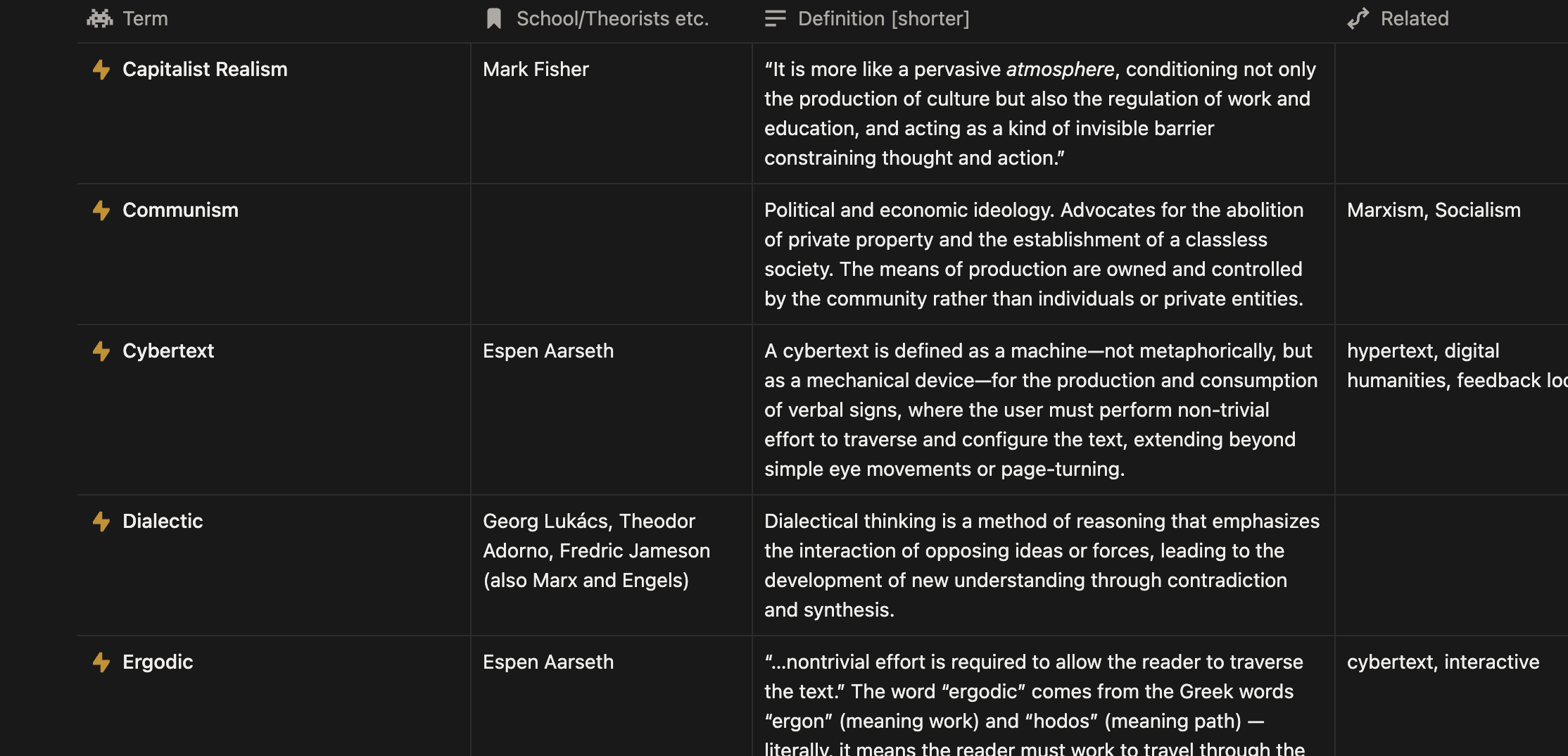
i write and update a dictionary of theoretical terminologies. it's a pain, but it is very helpful. this week, for my independent study, i am reading about lacan's (freud's) The Letter. i went to update my dictionary, but here i am on a sunday night at 11.40p, with my fourth cup of coffee, and an ungodly amount of books & pdfs & notes open, not knowing how. so, this was my attempt.